The technological landscape in New South Wales is shifting at an unprecedented velocity. As the Minns Government continues to pour investment into the “Tech Central” precinct in Sydney and regional hubs like Wollongong and Newcastle, the demand for high-tier networking expertise has never been higher. However, for students enrolled in Information Technology and Computer Science programs across the state, a significant barrier has emerged.
In 2026, Computer Networking has officially overtaken software development and data analytics as the primary academic “pain point” for NSW tertiary students. Whether studying at the University of Sydney, UTS, or UNSW, undergraduates are finding that the theoretical complexities of the OSI model, combined with the rigorous demands of the new 2024 NSW Syllabus updates for secondary and vocational education, are creating a perfect storm of academic pressure.
The Evolution of the NSW Tech Curriculum
The difficulty isn’t just a matter of perception; it is rooted in the increased complexity of the curriculum. The recent integration of the New South Wales Education Standards Authority (NESA) updated guidelines has trickled up into tertiary expectations. Modern networking is no longer just about connecting cables; it involves intricate cloud architecture, cybersecurity protocols, and virtualized environments.
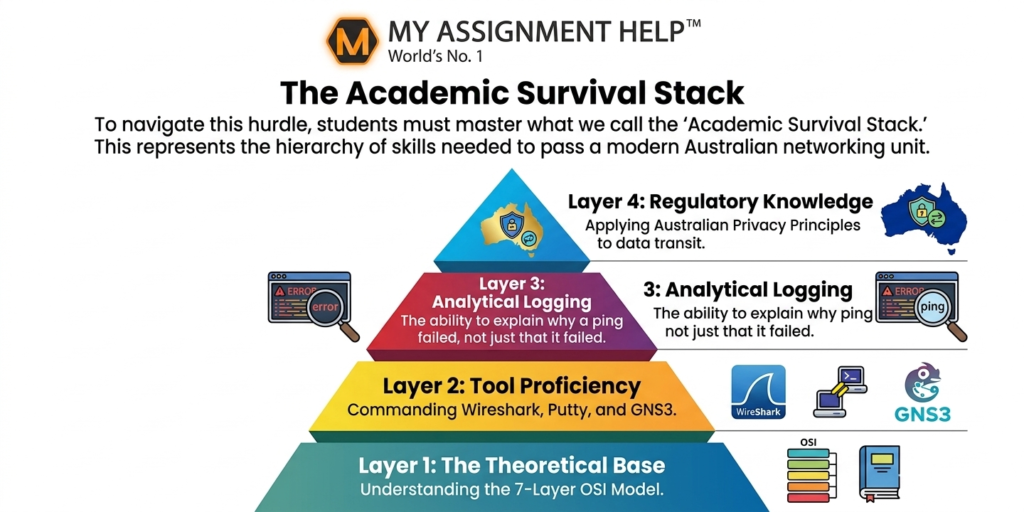
For many students juggling part-time work and full-time study, the technical depth required to master Cisco Packet Tracer simulations or Wireshark packet analysis is overwhelming. This has led to a surge in students seeking professional networking assignment help to bridge the gap between classroom theory and practical application. These services provide the necessary scaffolding for students to understand how data encapsulation works in a live environment, rather than just memorizing definitions for an exam.
Why Networking is the New “Gatekeeper” Subject
1. The Convergence of Hardware and Software
The line between a software engineer and a network engineer has blurred. With the rise of Software-Defined Networking (SDN), students are expected to write code to manage hardware. This dual requirement means students who excel at coding often struggle with the physical logic of routing and switching, while those who understand hardware struggle with the automation scripts now required by Australian universities.
2. The High Stakes of Cybersecurity
In a post-Medibank and Optus hack era, Australian academic standards for networking have pivoted sharply toward security. Every networking assignment now carries a heavy weighting on “Security by Design.” Students aren’t just asked to build a network; they must prove it can withstand a simulated DDoS attack or a sophisticated SQL injection via a misconfigured gateway.
3. The Complexity of Hybrid Cloud Environments
Most NSW tech firms have moved to hybrid cloud models. Consequently, universities like Macquarie and UOW have updated their labs to include AWS and Azure integration. Students are no longer just configuring a Local Area Network (LAN); they are orchestrating Wide Area Networks (WAN) that span across global regions, requiring a mastery of latency, throughput, and jitter—concepts that are notoriously difficult to visualize.
Data Insight: Student Performance Trends 2024–2026
Recent internal data and academic surveys across major Sydney-based universities suggest a notable trend:
- Failure Rates: Introductory networking units have seen a 12% increase in “Withdrawal Without Academic Penalty” cases compared to 2023.
- Demand for Support: There has been a 40% year-on-year increase in students searching for an online assignment writer to assist with complex network topology reports and configuration logs.
- Industry Gap: While 85% of NSW tech students want to work in AI, only 30% feel confident in the underlying network infrastructure that makes AI possible.
The Role of Professional Mentorship
Navigating these challenges requires more than just reading a textbook. It requires an understanding of how the Australian Computer Society (ACS) professional standards apply to real-world scenarios. Many students find that professional guidance helps them decode the “Working Mathematically” and “Problem Solving” focus that is now central to the NSW curriculum.
By engaging with experts who understand the specific nuances of the Australian academic system—including the specific marking rubrics used by TAFE NSW and the Group of Eight universities—students can ensure their submissions meet the high E-E-A-T standards expected by modern lecturers.
Key Takeaways
- Curriculum Shift: NSW tech units are moving away from simple “plug and play” labs to complex “Security-First” architectures.
- The SDN Factor: Programming skills are now mandatory for networking, creating a double-sided challenge for students.
- Regulatory Compliance: Assignments must now reflect Australian data laws, adding a legal layer to technical tasks.
- Expert Support: Utilizing professional academic writers is becoming a standard strategy for managing the high-density workload of 300-level networking units.
See also: Open Source Operating Systems
Frequently Asked Questions (FAQ)
Q: Why is Cisco Packet Tracer so difficult for NSW students?
A: Packet Tracer requires a granular understanding of CLI (Command Line Interface). Many students accustomed to GUI-based systems find the syntax-heavy environment of IOS (Internetwork Operating System) difficult to master without one-on-one guidance.
Q: Does the Australian curriculum differ significantly from the US or UK?
A: Yes. The Australian curriculum places a much higher emphasis on the Australian Privacy Principles (APPs) and specific cybersecurity frameworks mandated by the Australian Signals Directorate (ASD).
Q: Can I get help with regional TAFE NSW networking assignments?
A: Absolutely. Specialized academic services tailor their content to the specific competency units required by TAFE, ensuring that practical assessments meet the national VET (Vocational Education and Training) standards.
Author Biography
Lachlan Vance is a Senior Content Strategist and Academic Consultant at MyAssignmentHelp. With over 12 years of experience in the Australian EdTech sector, Lachlan specializes in bridging the gap between industry requirements and academic performance. Holding a Master’s in Information Technology from the University of Technology Sydney (UTS), he has helped thousands of students navigate the complexities of the NSW tech curriculum, focusing on E-E-A-T compliant technical writing and search engine visibility for educational resources.
References
- Australian Computer Society (ACS) – Australia’s Digital Pulse 2025 Report.
- NSW Education Standards Authority (NESA) – Technology 7–10 Syllabus 2024.
- University of Sydney – School of Computer Science Annual Academic Review.
- Australian Signals Directorate (ASD) – Strategies to Mitigate Cyber Security Incidents.